Time is life
as memory.

Johann Christian Hasse Foundation

2014-2026

"Because time remembers.
And what we build now
will remain."

In 2014, a realization emerged—not as theory, but as lived understanding: time is life as memory. Time is not an external container in which events occur. It is the way life records itself. It is continuity, inscription, and consequence.

Every action leaves a trace. Every structure carries history. Nothing that truly matters is reversible.

That insight did not arise from books or institutions. It arose from experience—through the body, through territory, through the slow recognition that life is shaped not by isolated moments, but by what endures, accumulates, and binds. Only later did language catch up. Only later did philosophy, law, and systems theory provide names for what had already been lived.

This understanding reframes responsibility. If time is memory, then every decision participates in the future. Law, in this light, cannot be merely reactive. It must be architectural. It must be capable of holding continuity, preventing irreversibility, and preserving the conditions that allow life—human and non-human—to persist.

The Hasse Foundation stands within a lineage that understood this long before the present moment demanded it.

Across generations, its figures approached the same intuition from different domains: philosophy and theology, science and medicine, law and institutional design, urbanism and ecology. They did not share a doctrine, but a method—a way of thinking in which systems were understood as living structures, governed by internal logic, memory, and limits.

From the rational cosmology and institutional discipline of the Weber tradition, to the juridical architecture articulated by Johann Christian Hasse; from the botanical and medical systems thinking of Georg Heinrich Weber, to the urban ecological practice realized in the Amazon by Eduard Johannes Heinrich Hass, the same principle recurs: life cannot be governed as if it were static, fragmentary, or reversible.

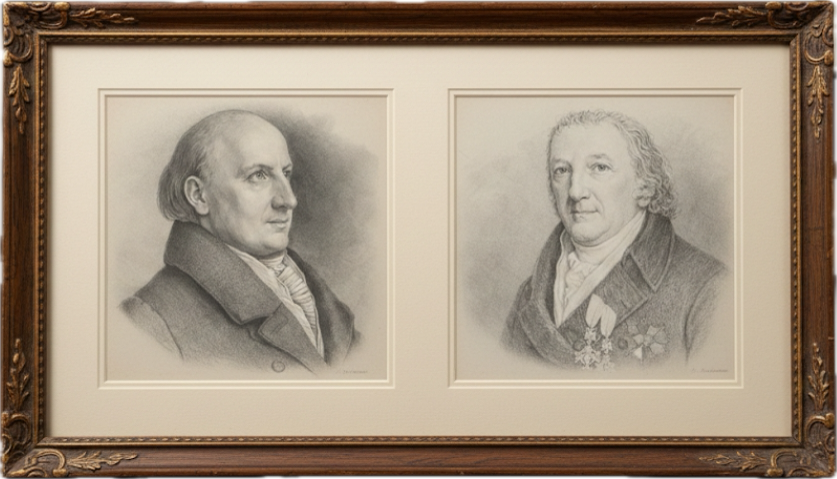
Portrait of Johann Hasse & Georg Weber

Johann C. Hasse | Georg H. Weber

Christian-Albrechts-Universität zu Kiel

They understood that institutions are not inert. That systems are living structures. That order, when designed with rigor and care, can protect life across time.

History also records the cost of forgetting this. Tragedy, collapse, displacement, political rupture, and ecological constraint are part of this lineage's memory as well. They are not failures to be erased, but lessons inscribed in time—evidence of what occurs when systems are pushed beyond their limits.

This Foundation exists to hold that memory.

It exists to support work that refuses immediacy in favor of continuity. That treats law as a structure of responsibility rather than control. That understands ecology not as an external concern, but as an ontological condition. That recognizes time as the deepest system of all.

The c-ECO Doctrine is one expression of this inheritance—not as culmination, but as translation. It brings into legal form what life has always known: that systems endure, that damage accumulates, and that care must precede harm.

This publication is not an archive of the past. It is a commitment to the future.

Feature Story

Institutions Are Living Structures

Institutions are often treated as static objects: buildings, statutes, procedures, offices, titles. Law schools teach them as architectures of competence; political theory frames them as instruments of authority; economics reduces them to incentive containers. But this view misses their most decisive characteristic.

Institutions are not inert. They live.

They persist through time, accumulate memory, respond unevenly to pressure, resist change, adapt slowly, and—under certain conditions—collapse irreversibly. Like living systems, institutions carry histories within their structure. They remember what they were designed to do, even when actors forget. And they constrain what can be done long after their original authors are gone.

To understand institutions merely as rules is to misunderstand their nature. Rules can be amended overnight. Institutions cannot. They metabolize change.

This is why institutional failure is rarely sudden. It is preceded by long periods of internal stress, distortion, delay, and denial—signals that are visible only when one understands institutions as temporal organisms rather than mechanical devices.

Law as Temporal Architecture

Within the German intellectual tradition of the late eighteenth and early nineteenth centuries, this insight was already present, though rarely articulated in contemporary terms. Jurists such as Friedrich Carl von Savigny and Johann Christian Hasse did not conceive law as an instantaneous command backed by force. Law, for them, was a historical structure—a framework that allowed social life to flow through time with order, continuity, and intelligibility.

Savigny's historical jurisprudence insisted that law emerges organically from the life of a people (Volksgeist), not from abstract rational design detached from history. Hasse, working within this same intellectual atmosphere, translated that insight into institutional form. As a professor and later Rector of the University of Bonn, he understood that legal institutions were not neutral containers of action. They were formative structures, shaping conduct over generations.

The jurist, in this view, was not merely an interpreter of norms, but a constructor of temporal frames—someone responsible for designing legal forms capable of enduring without suffocating life itself.

This conception implies a profound responsibility: if institutions live through time, then bad institutional design does not merely fail—it harms future generations by locking them into rigid trajectories they did not choose.

Why This Still Matters

Modern legal systems, especially in the context of ecological and technological risk, continue to operate as if institutions were neutral tools and contracts were isolated acts. They are not.

Every institution carries memory. Every contract creates trajectory. Every system accumulates pressure.

The failure to recognize institutions as living structures explains why law so often intervenes too late—after harm has become irreversible, after futures have been foreclosed.

This is the unresolved gap the Hasse Foundation exists to explore.

Not nostalgia. Not genealogy for prestige. But continuity of method: thinking law, institutions, and systems as temporal, living architectures that must be designed with care for life—human and non-human—across time.

Kiel to the Amazon

A Family of Thought

Origin & Public Governance

Kiel

Andreas Weber and Georg Heinrich Weber were not merely theorists; they served as Rectors of the University of Kiel and as distinguished public administrators. In these leadership roles, they transformed rationalism into early systems biology. They understood that nature imposes biological and systemic limits that cannot be legislated away—integrating scientific discipline directly into the heart of state administration.

Juridical Architecture

Bonn

Johann Christian Hasse, also a Rector of the University of Bonn, translated this systemic legacy into the legal realm. He conceived law as a temporal architecture, framing the jurist not merely as an interpreter of norms, but as a designer of institutional durability. His leadership at Bonn structured the technical frameworks of 'culpa' and 'actio', ensuring the legal system's logical coherence and historical grounding, and solidified the responsibility of the law toward the future shape of society.

Territory & Execution

Belém

Eduard Hass carried this legacy of rectors and administrators into the Amazon. In Belém, systemic thought ceased to be academic and became physical infrastructure. Botany was deployed as public health, and engineering was submitted to climate. The administrative rigor inherited from Kiel and Bonn became the literal shade that protects the citizens of the Amazon to this day.

Column: 2014

The Birth of c-ΣCO

"Time is not something that passes outside of us. Time is what remains inside of us."

There are forms of knowledge that do not arise from abstraction, but from recognition. They are not conceived as theories, but apprehended as realities already at work. The foundational intuition of what would later become the c-ECO Doctrine emerged in this way in 2014—not as a response to a regulatory gap, nor as a conceptual exercise, but as a lived understanding of time and of its juridical significance for life.

What became clear was not merely that harm unfolds over time, but that time itself is the medium through which life records consequence. Law, as traditionally structured, had failed to account for this fact.

A Lineage of Method, Not of Theory

Although its legal articulation is recent, the intellectual impulse sustaining c-ECO is not. It belongs to a lineage in which law, science, and institutional responsibility were understood as continuous structures rather than isolated acts. Following the trajectory of this lineage, I crossed the Atlantic and entered the legal environment of the United States.

It was within the technical rigor of American contract law—its emphasis on structure, enforceability, and design—that an inherited intuition could finally assume juridical form. c-ECO is therefore not a departure from tradition, but the maturation of a method: an understanding of responsibility grounded in continuity, constraint, and consequence.

Time as Structure: Life as Memory

The premise of the doctrine is both simple and irreversible: time is life as memory.

Time is not merely what passes. It is what remains. It is the accumulation of relations, the sedimentation of actions, and the inscription left by every interaction between bodies, territories, and systems. Life does not occur within time as an external container; life constitutes time insofar as it records, carries, and transforms experience.

Every contractual decision leaves a trace. Every legal structure inscribes memory.

Memory Beyond Recollection

When c-ECO asserts that systems remember, it does so in an ontological sense. Memory is not psychological recollection, but structural persistence. Territories remember through degradation and resilience. Institutions remember through rigidity, inertia, and collapse. Bodies remember through thresholds beyond which repair is no longer possible.

This recognition transforms the meaning of responsibility. Responsibility ceases to be merely retrospective—an allocation of blame after failure—and becomes a forward-looking obligation toward the future. If systems retain the memory of what is done to them, law must ensure that this memory does not become a permanent record of irreversibility.

From Harm to the Design of Obligation

If harm is cumulative rather than instantaneous, law cannot remain reactive. The central question posed by the c-ECO Doctrine is therefore not remedial, but architectural:

How must legal obligations be designed so that irreversible memory is never inscribed into living systems?

Under c-ECO, contracts are no longer static instruments. They become temporal architectures—structures calibrated to operate before thresholds of collapse are crossed. Legal validity is linked not only to consent and enforceability, but to the preservation of systemic integrity in a context of acceleration, extraction, and ecological constraint.

The Discipline of Continuity

At its core, the c-ECO Doctrine is a discipline of care. It holds that the legitimacy of a legal act is inseparable from its capacity to sustain habitability—social, environmental, and intergenerational. The moment of recognition in 2014 was not an academic event, but a convergence: inherited systemic awareness meeting juridical technique.

It marks the point at which law is compelled to accept its most demanding function—not merely to regulate behavior, but to honor the memory of life in order to protect the future.

1779–1830

Johann Christian Hasse

"Law as System, Institution, and Temporal Order."

Johann Christian Hasse was born on 24 July 1779 in Kiel and stands as one of the most significant jurists of his generation within the German historical tradition of law. He was distinguished equally as a Romanist and a Germanist, combining rigorous historical method with exceptional clarity of legal exposition.

Hasse received his early education at the Husum Classical School and pursued legal studies at the University of Kiel, where he became Doctor of Law in 1811. Already from 1805, he served as Privatdozent and University Syndicus, participating directly in the legal-administrative life of the university.

In 1811, Hasse was appointed to Jena, where he combined academic work with service as a Senior Judge at the Higher Court of Appeal (Oberappellationsgericht). He subsequently held academic positions in Königsberg (1813) and Berlin (1818), before assuming the chair of law at the University of Bonn (1821–1830) as Full Professor of Law, where he taught until his death on 18 November 1830.

Legal Method and Institutional Thought

Hasse's scholarship is characterized by an exceptional depth of analysis combined with a restrained, precise, and elegant style. His work reflects a conception of law not as an abstract normative system detached from social reality, but as a historically embedded institutional structure, shaped by doctrine, practice, and continuity over time.

His principal works include: Beiträge zur Revision der bisherigen Theorie von der ehelichen Gütergemeinschaft (1808); An novatio voluntaria esse possit citra stipulationem? (1812); Die Culpa des römischen Rechts (1815; second edition edited by Bethmann-Hollweg, 1838); Das Güterrecht der Ehegatten nach römischem Recht (1824); and De variis eorum sententiis… (1827).

From 1827, Hasse served as co-editor of the Rheinisches Museum für Jurisprudenz alongside Blume, Puchta, and Peter Gottlieb Eduard Puggé, situating him at the core of nineteenth-century debates on the historical and systematic foundations of law.

Law as a Living Institutional System

Across his academic and judicial career, Johann Christian Hasse consistently treated legal doctrine as a living institutional system rather than a static set of rules. Courts, universities, and legal concepts possessed continuity, internal logic, and historical inertia. Responsibility, in this view, was not limited to individual acts, but distributed across institutional arrangements that persist through time.

This understanding situates Hasse firmly within a tradition that recognizes the temporal nature of law, the interdependence between legal doctrine and institutional form, and the idea that legality itself can become structurally misaligned with evolving social and material conditions.

Methodological Affinity with the c-ECO Doctrine

The methodological affinity between Johann Christian Hasse's legal thought and the c-ECO Doctrine lies not in subject matter, but in structure. Hasse approached law as historically constrained, institutionally embedded, and operative across generations.

Similarly, the c-ECO Doctrine treats legal and contractual systems as temporal architectures that must internalize structural constraints—now understood as ecological thresholds and systemic limits—before irreversible outcomes occur.

Where Hasse emphasized that legal responsibility cannot be reduced to isolated decisions detached from institutional continuity, c-ECO extends this logic to the planetary scale: legal systems themselves can become drivers of systemic harm when they fail to register the limits of the systems they govern.

Position within the Lineage

As the juridical pillar of the lineage, Johann Christian Hasse provides the institutional and temporal grammar that complements the cosmological and philosophical systems thinking of Andreas Weber, the scientific and ecological empiricism of Georg Heinrich Weber, and the territorial application of systemic knowledge later realized in the Amazon by Eduard Johannes Heinrich Hass.

Within this lineage, Hasse represents the moment at which systemic thinking becomes legal architecture—a necessary condition for the later emergence of c-ECO as a framework capable of translating ecological reality into juridical form.

1718–1781

Andreas Weber

Cosmology, System, and Institutional Order."

The deepest intellectual root of this lineage lies in the Weber tradition, inaugurated by Andreas Weber (1718–1781)—philosopher, Lutheran theologian, and senior academic administrator in the German university system of the eighteenth century.

Formed within the rationalist school of Christian Wolff, Andreas Weber advanced a conception of reality in which nature, morality, law, theology, and institutional order formed a single intelligible system. His central concern was not the sovereignty of the individual subject, but the conditions under which a finite human mind could understand and operate within a larger rational cosmos.

Crucially, Andreas Weber was not only a theorist. His career places him at the intersection of knowledge production and institutional governance, at a time when universities functioned as integral components of state administration.

Academic and Institutional Roles

Between 1742 and 1749, Andreas Weber served as Privatdozent in Mathematics and Philosophy at the Friedrichs-Universität Halle, combining formal instruction with early institutional responsibility.

In 1749–1750, he was appointed Associate Professor of Philosophy at the Georg-August-Universität zu Göttingen, followed by promotion to Full Professor of Philosophy (1750–1770). During this period, he also served as Vice-Rector (1753–1754), participating directly in the governance of one of the most influential universities of the German Enlightenment.

From 1770 to 1781, Andreas Weber held senior positions at the Christian-Albrechts-Universität zu Kiel, where his academic and administrative roles converged. He served as Associate Professor of Theology, Full Professor of Metaphysics, Logic, and Mathematics, and Vice-Rector in 1771 and again in 1777.

These roles situate Andreas Weber firmly within the state–university nexus of his time, where education, moral formation, scientific knowledge, and public order were treated as interdependent dimensions of governance.

Major Work and the Principle of Systemic Coherence

The intellectual orientation of Andreas Weber is most clearly articulated in his principal work, Die Übereinstimmung der Natur und Gnade (The Concordance of Nature and Grace), a foundational text of Protestant Enlightenment theology influenced by the rationalist philosophy of Christian Wolff.

In this work, Weber advances a decisive premise: grace does not operate in contradiction to nature, but in structural coherence with it. Addressing readers trained in scientific and philosophical reasoning, Weber explicitly rejects belief without justification. He argues that those who have exercised their intellect in the sciences require grounds, internal consistency, and rational explanation for any principle meant to guide life, conduct, or welfare.

For Weber, systems—whether natural, moral, or theological—do not function through exception or rupture. They operate through order, continuity, and intelligible structure. Intervention is legitimate only when it aligns with the internal logic of the system itself.

In contemporary c-ECO terms, this represents an early articulation of systemic coherence and memory: systems carry internal constraints shaped by their own nature and history, and any form of governance that ignores those constraints becomes unstable or destructive.

This principle, articulated by Andreas Weber in theological language, reappears transformed but intact, in the c-ECO Doctrine. Where Weber argued that grace must respect the structure of nature, c-ECO holds that law and decision-making must respect the structure, limits, and accumulated memory of ecological systems.

The continuity is methodological rather than doctrinal. It lies in the shared conviction that no system can be sustainably governed from the outside.

Cosmology, Governance, and Systemic Memory

Within this institutional context, Andreas Weber developed a worldview in which systems precede individuals and order precedes choice. Reason did not separate humanity from the world; it integrated human action into a larger architecture governed by coherence, proportion, and limits.

In contemporary c-ECO terms, Andreas Weber's work anticipates the idea of systemic memory, in which institutions carry accumulated structures that constrain present and future decisions; governance as continuity, through which authority operates across time rather than by momentary command; and embedded responsibility, whereby individual action is always situated within inherited institutional and moral frameworks.

This combination of cosmological rationalism and institutional governance constitutes the earliest articulation of what later becomes the "memory of life" within the c-ECO Doctrine: the recognition that systems—natural, legal, and institutional—do not reset at each decision point, but operate through historically accumulated constraints.

Andreas Weber as Foundational Influence on Georg Heinrich Weber

The intellectual formation of Georg Heinrich Weber cannot be understood without recognizing the decisive influence of his father, Andreas Weber. Georg did not inherit merely a household of books, but a method of thinking forged at the intersection of philosophy, mathematics, theology, and metaphysics.

Growing up in an environment shaped by Andreas Weber's academic and administrative roles, Georg was exposed from an early age to the idea that knowledge forms a coherent system, not a collection of isolated disciplines. Mathematics provided structure and proportion; philosophy offered logical architecture; theology framed moral order; and metaphysics supplied the conceptual bridge between abstract reason and the material world.

This interdisciplinary formation deeply shaped Georg Heinrich Weber's later scientific work. His approach to medicine and botany was never purely empirical or technical. Instead, it reflected a philosophically grounded understanding of living systems—where organisms, environments, and institutions operate according to intelligible, interrelated principles.

This father–son transmission represents an early articulation of systems thinking grounded in multiple epistemic layers. Georg's scientific practice carried forward Andreas Weber's conviction that reality is structured, ordered, and historically conditioned—an insight that later reappears in c-ECO as the integration of scientific signals, institutional design, and temporal responsibility.

This continuity explains why Georg Heinrich Weber was able to move seamlessly between medicine, botany, education, and public governance. His work did not reduce life to mechanics, nor dissolve it into abstraction. It treated living systems as structured wholes, capable of being studied, cared for, and governed—yet never fully controlled.

1752–1828

Georg Heinrich Weber

"Science as system, not control."

That orientation deepened with Georg Heinrich Weber (1752–1828), physician, botanist, professor, and later Rector of the University of Kiel. His work marked a decisive shift: from philosophical system to biological system.

As founder of Kiel's botanical garden and a central figure in medical education, Georg Heinrich Weber understood life as relational, fragile, and internally regulated. Bodies—human or vegetal—were not machines to be commanded, but systems to be observed, respected, and supported.

Here, a crucial insight enters the lineage: nature imposes limits. Health, growth, and decay obey logics that cannot be legislated away. Institutions, if they are to endure, must learn from living systems rather than attempt to override them.

The Weber line thus transformed rationalism into early systems biology—still disciplined, still institutional, but increasingly aware of vulnerability and irreversibility.

Scientific Works and Botanical Legacy

The scientific legacy of Georg Heinrich Weber is anchored in a substantial body of botanical scholarship that reflects the methodological foundations of his time: systematic observation, empirical classification, and attention to ecological context. His work focused primarily on cryptogamic plants, lichens, and regional flora—organisms that exist at the margins of visibility yet play a decisive role in ecological stability.

Weber's publications demonstrate a consistent effort to document local ecosystems as coherent systems, shaped by climate, soil, and geographic continuity rather than abstract universality. This regional, system-based approach anticipates later ecological thinking by treating flora as embedded within living territorial structures.

Principal Botanical Works

Among his most significant contributions are Spicilegium Florae Goettingensis (1778), an early botanical work illustrating plants of the Göttingen region with particular emphasis on cryptogamic species, reflecting Weber's commitment to empirical observation and careful taxonomic method; Primitiae Florae Holsaticae (1780–1787), his foundational study of the flora of Holstein, documenting plant life across the region and establishing a scientific baseline for understanding local biodiversity and ecological continuity; and Novitiae Florae Holsaticae (1826), a later supplement expanding and refining his earlier botanical surveys in collaboration with subsequent generations of botanists, reflecting the cumulative nature of scientific knowledge and long-term ecological observation.

These works were produced in collaboration with other prominent naturalists of the period, including Friedrich Heinrich Wiggers, Johann Christian Kerstens, and Ernst Ferdinand Nolte, reinforcing Weber's role within a networked scientific community rather than as an isolated scholar.

Methodological Significance

Weber's botanical corpus is notable not for speculative theory, but for systematic documentation of living systems over time. His work embodies principles that resonate directly with the c-ECO Doctrine, including the recognition of ecological memory, whereby flora is understood as historically situated and shaped by accumulated conditions rather than instantaneous states; territorial specificity, in which ecological knowledge is grounded in place rather than abstraction; and interdependence, treating plants as part of broader biological and environmental systems rather than isolated specimens.

This methodological orientation informed Weber's institutional initiatives, including the founding of the university-linked botanical garden in Kiel in 1802, which functioned as a living archive of regional ecology, medical knowledge, and educational practice.

From Botanical Memory to Legal-Ecological Memory

Within the c-ECO framework, Weber's work illustrates an early form of what is now described as the "memory of life": the recognition that living systems retain the imprint of past conditions, classifications, and interventions. Just as Weber's flora studies required continuity, revision, and respect for natural structure, c-ECO treats ecological thresholds as historically accumulated constraints that must be integrated into legal and institutional decision-making before irreversibility occurs.

Through his scientific publications and institutional contributions, Georg Heinrich Weber stands as a key transitional figure in the lineage—bridging the philosophical system-thinking inherited from Andreas Weber with empirical ecological practice that would later find territorial expression in the Amazon through Eduard Johannes Heinrich Hass.

1874–1908

Eduard Johannes Heinrich Hass

"From Europe to the Amazon: System Becomes Territory."

The most radical transformation of the lineage occurs when it leaves Europe altogether.

With Eduard Hass, the family of thought exits the university and enters the Amazon. Born on June 3, 1874, in Kiel, Germany, Hass was trained in the European tradition of botanical science and landscape architecture. He did not become a professor. He did not become rector. Instead, at the age of twenty-five, he emigrated to Brazil, arriving in Belém do Pará around 1899, carrying with him a systemic sensibility forged in the scientific gardens of Northern Europe.

He found a city awakening to its own modernity at the height of the rubber boom. On August 16, 1900, he married Francisca Cardoso de Oliveira Martins, establishing roots in his adopted homeland. The couple would have five children: Clara (1901), Mathilde (1902-1903), Rodolfo (1904), Alvina (1906), and Ida (1907). Two of their children died in infancy—a tragedy that marked the family's early years in the tropics.

Under the administration of Intendant Antônio Lemos (1897-1910), Hass was appointed Chief of Municipal Gardening and director of the Bosque Rodrigues Alves. He became the executive arm of Lemos's ambitious urban vision, leading one of Brazil's earliest municipal departments dedicated to parks and gardens. While the Intendant supplied political authority and financial resources, Hass provided the technical and ecological intelligence that made modernization viable in the Amazonian environment.

Here, systems ceased to be theoretical. They became climatic, botanical, urban, and biological. Decisions about trees became decisions about public health. Urban design became ecological intervention. Knowledge became irreversible.

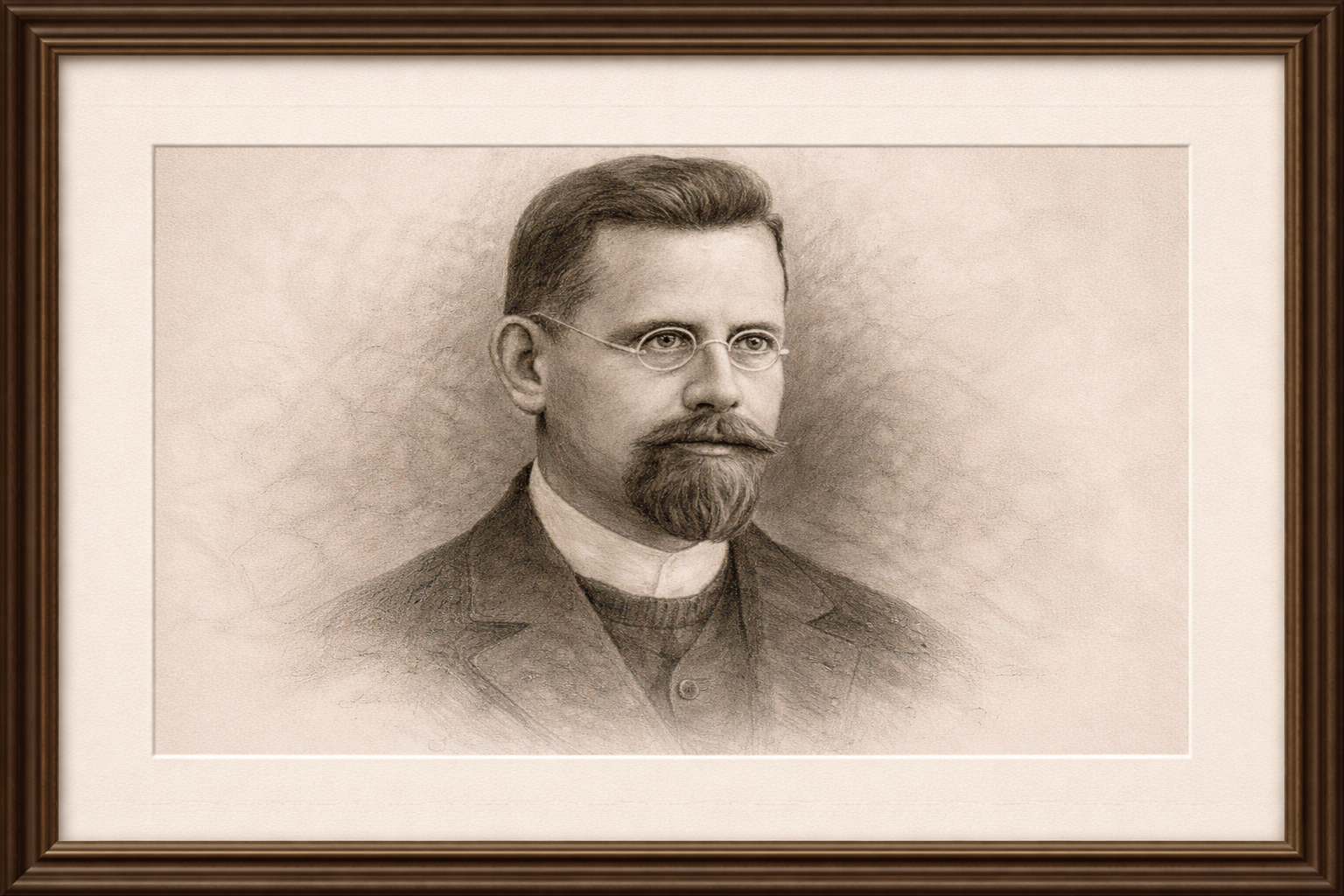
Portrait of Eduard Johannes Heinrich Hass

Eduard Johannes H. Hass

June 3, 1874 – January 15, 1908

The Municipal Horto: Cultivation as Infrastructure

Central to Hass's methodology was the creation of the Municipal Horto, established on a modest plot at the corner of Mundurucús and Dr. Moraes streets. Under his direction, this nursery became the productive engine of Belém's transformation, supplying thousands of seedlings for streets, squares, and avenues throughout the city. The Horto operated with fiscal efficiency that justified its existence to municipal administrators—vegetation as infrastructure, cultivation as public service, beauty as economy.

The Horto embodied Hass's systemic approach to urban management. Rather than relying on expensive imported plants or unpredictable extraction from native forests, he created a self-sustaining production system. Mango trees, eucalyptus, and native species were cultivated in abundance, ready for deployment across the urban fabric. This institutional innovation ensured continuity: the trees planted in one administration would be maintained and replaced through the same productive infrastructure.

The Urban Forest: Arborization as Climate Infrastructure

Hass's most visible and enduring legacy lies in the systematic arborization of Belém's streets and avenues. Working under Lemos's directive to "domesticate the wild landscape" according to European aesthetic ideals, Hass transformed the city's urban fabric through strategic tree planting.

The mango trees (Mangifera indica) that became enduring symbols of Belém were his deliberate choice, promoted for their dense foliage, rapid growth, and resilience in equatorial conditions. These were not merely ornamental additions—they formed part of a calculated strategy for microclimate regulation, providing shade and transpiration that measurably reduced ground temperatures across the city center.

Under Hass's direction, the Municipal Horto and the Museu Goeldi supplied thousands of seedlings for the ornamentation of streets, squares, and avenues. The process was systematic: older trees were replaced, new avenues were lined with uniform plantings, and the city's vegetal structure became an integral component of its modernization. Belém's subsequent identity as "the city of mango trees"—with canopy coverage reaching 30% of the urban area—derives directly from these interventions.

The arborization extended beyond aesthetics to public health. In an era when tropical diseases were poorly understood, Hass's tree-planting strategy addressed miasmatic theories of disease transmission while creating the "healthy city" envisioned by hygienist reformers. The living infrastructure he planted continues to regulate the urban climate over a century later.

Praça da Independência: The First Intervention

The transformation of Praça da Independência marked Hass's earliest systematic intervention in Belém's urban fabric. Where previous administrations had created rigid, symmetrical gardens that "irritated the most calm passerby" with their "fatiguing symmetry," Hass introduced a mixed system of gardening and arborization that would become the hallmark of the Lemos administration.

He retained the cement walkways in their X-shaped configuration but introduced irregular flowerbeds to break visual monotony. More significantly, he established extensive plantings of mango trees, eucalyptus, and other species that would, in a few years, produce the dense shade necessary for human comfort in equatorial conditions. The square became a "picturesque corner of delicious freshness"—a green refuge for the dense population of the surrounding commercial district.

Praça da República: The Civic Heart

The transformation of the former Largo da Pólvora into Praça da República represents one of Hass's most complex urban compositions. The expansive site was divided into three distinct quadrilaterals of varying sizes, creating autonomous spatial units integrated through peripheral tree-lined alleys and internal massings of vegetation.

The largest quadrilateral—then known as Parque João Coelho—received the most elaborate treatment, with dense arboreal masses creating a green counterpoint to the neoclassical Theatro da Paz and the marble Monumento à República. The square became a curated gallery of European industrial elements embedded within living systems: cast-iron bandstands, fountains, and the characteristic "mock ruins" that Hass introduced throughout Belém's parks.

Following English Garden principles, the design rejected rigid symmetry in favor of organic, seemingly spontaneous arrangements. Yet every element served functional purposes: the trees regulated temperature, the water features moderated humidity, and the winding paths guided movement while creating visual discovery. The square became the city's primary stage for civic life—a "culture polygon" where the rubber elite displayed their Parisian fashions amidst Hass's constructed nature.

Bosque Rodrigues Alves: The Engineered Wilderness

As director of the Bosque Rodrigues Alves, Hass executed the most ambitious landscape intervention of the Belle Époque. Originally inaugurated in 1883 and inspired by Paris's Bois de Boulogne, the municipal park had deteriorated by the 1890s. Hass, in collaboration with architect José de Castro Figueiredo, transformed it into a sophisticated constructed landscape.

The project introduced artificial grottos, streams with rustic bridges, cascades, and the "false ruins" that became signatures of Hass's work. These were not mere decorative follies—they created microclimates, provided structural support for vegetation, and established viewpoints that framed the "engineered wilderness." The rocaille techniques used to sculpt bridges and structures to resemble tree branches dissolved boundaries between built form and vegetation.

The Bosque became a space of elite recreation, located at the Marco da Légua—then distant from the city center, now absorbed by urban expansion. Its artificial lakes, ornamental pavilions, and curated botanical collections demonstrated that European landscape aesthetics could be successfully translated to equatorial conditions. The park remains one of Belém's most significant public spaces, its essential character preserved despite subsequent modifications.

Praça Batista Campos: The Synthesis

The transformation of the former Praça Sergipe into Praça Batista Campos represents the most refined synthesis of Hass's methods. Working with the largest budget and most extensive site of his career, Hass created what is widely regarded as one of Brazil's most beautiful public spaces.

The project departed completely from French geometric models, embracing English Garden asymmetry at a monumental scale. Winding paths, interconnected streams, artificial lakes, and the characteristic soundscape of flowing water created an environment that appeared "wild" yet was entirely constructed. The botanical palette combined native Amazonian species—sumaúmas, palms, Pau-Brasil—with acclimatized exotics, forming multi-layered canopies that performed ecological functions while creating visual drama.

German and French cast-iron elements, including the Chafariz das Sereias, were integrated as functional nodes within the landscape. The small Castelinho at the square's center served practical functions while maintaining the fantasy aesthetic. Every element, from tree placement to water circulation, served dual purposes: aesthetic and climatic, ornamental and infrastructural.

The English Garden in the Tropics

Hass's methodology derived from the English landscape tradition, adapted to Amazonian conditions. This approach rejected the rigid formalism of French gardens in favor of asymmetrical compositions that simulated natural landscapes while maintaining artistic control. The "mock ruins" scattered through his parks—stone structures suggesting ancient decay—were not merely picturesque; they provided habitat for vegetation, created microclimates, and established focal points within the landscape.

The technique of rocaille—sculpting artificial stone to resemble natural formations and tree branches—allowed built structures to dissolve into vegetal surroundings. This was not deception but integration: the recognition that in the tropics, the boundary between constructed and natural must be porous for both to survive.

Central to all Hass's projects was the creation of self-regulating microclimates. Tree species were selected for canopy density, evapotranspiration capacity, and shade performance. Water systems were engineered for continuous circulation, moderating heat and humidity while producing the characteristic soundscapes of his parks. These were not decorative water features but thermal infrastructure, essential for human comfort in equatorial conditions.

The Visionary Duo: Politics and Ecology

The transformation of Belém's public spaces illustrates the complementary roles of Hass and Intendant Antônio Lemos. Lemos, guided by hygienist and modernizing ideals, envisioned monumental urban reform as an instrument of progress and international legitimacy. He established the institutional framework: the Municipal Horto, the Service of Parks and Gardens, the legal and financial structures necessary for sustained intervention.

Hass supplied the ecological intelligence that made these ambitions viable. Where Lemos structured policy and budgets, Hass designed living infrastructure—trees, water, soil, and shade—without which modernization would have remained purely formal. Their collaboration represents one of the earliest systematic applications of landscape architecture to urban planning in Brazil.

Institutional Legacy and Premature Death

Hass died on January 15, 1908, at thirty-three years old, from tuberculosis contracted in the course of his work. He left behind a widow with three surviving children under seven years of age, and a city transformed. The institutional structures he helped establish—the Municipal Horto, the Service of Parks and Gardens—survived him, ensuring the continuity of his ecological approach to urban management.

The abrupt interruption of his work meant that many projects remained incomplete, and subsequent administrations modified or abandoned aspects of his vision. Yet the essential character of his interventions persisted: the mango trees continued to grow, the parks maintained their structures, and the principle that urban vegetation serves infrastructural functions became embedded in municipal governance.

Today, Belém's identity as "the city of mango trees"—with approximately 30% canopy coverage—derives directly from Hass's systematic arborization. The Bosque Rodrigues Alves, Praça da República, and Praça Batista Campos remain central to urban life, their essential configurations preserved despite a century of modifications. The "false ruins" have become genuine historical artifacts, their artificiality now marking authentic layers of the city's development.

Lineage and the c-ECO Continuum

The urban landscapes created by Eduard Hass crystallize the lineage that precedes the c-ECO Doctrine. From the philosophical systems of Andreas Weber, through the botanical science and public institutions of Georg Heinrich Weber, to the urban ecology practiced by Hass in Belém, the same method persists: life is structured, memory-bearing, and resistant to domination.

Hass's work demonstrates that governance succeeds only when it respects the systems it inhabits. The trees he planted not as decoration but as infrastructure; the water features engineered not merely for beauty but for thermal regulation; the parks designed not as isolated green spaces but as integrated urban systems—all prefigure the principles that c-ECO seeks to formalize juridically.

What Hass achieved empirically in the streets, squares, and parks of Belém—aligning urban form with ecological function, creating self-regulating systems that persist across generations—c-ECO seeks to establish as legal and institutional framework. The living city he built in water, trees, shade, and time remains his most enduring argument.
A Living Dossier

The Unfinished Question

"System, Memory, and Responsibility Across Time."

As the nineteenth century advanced, the lineage no longer moved along a single disciplinary axis. It widened. What had begun as philosophical system, botanical science, and juridical structure became increasingly entangled with politics, social rupture, and the emerging question of industrial modernity.

Within this expanded field appear figures whose historical visibility is uneven, but whose presence is nonetheless documented within the intellectual networks of the time. Their importance lies not in the creation of a unified doctrine, but in the dispersion of a shared method across divergent domains.

Friedrich Weber represents a moment of transition within the family tradition. Active in the nineteenth century, his work and correspondence situate him within scientific and philosophical circles shaped by post-Enlightenment rationalism and the growing influence of historical material conditions. Sources do not support the attribution of a single foundational theory to Friedrich Weber; rather, they indicate participation in an intellectual environment increasingly attentive to social structure, empirical constraint, and the limits of abstract system-building.

Eduard Puggé, a documented collaborator and editor within nineteenth-century German jurisprudence, appears not as a member of the Weber or Hasse families, but as part of the same institutional ecosystem. His involvement in legal periodicals and scholarly exchange situates him within the methodological circle that treated law as a historically situated system rather than a set of timeless commands. Puggé's role reinforces an important point: this lineage was never purely genealogical. It functioned through networks, journals, universities, and shared standards of rigor.

Ferdinand Weber emerges in the record as another carrier of scientific and institutional continuity. While surviving sources provide limited biographical detail, his work aligns with the nineteenth-century emphasis on disciplined observation, administrative responsibility, and the translation of knowledge into institutional form. Here again, the absence of grand theoretical authorship does not indicate insignificance. The lineage advanced as much through custodianship and execution as through innovation.

A more politically charged inflection appears with Georg Weber, son of Georg Heinrich Weber. This Georg must be carefully distinguished from his father. Historical correspondence places him within intellectual environments that overlapped with early socialist and materialist thought, including documented exchanges with figures in the orbit of Karl Marx. The surviving letters do not support claims of doctrinal alignment or formal collaboration. What they do reveal is exposure to a radically different register of systemic thinking—one in which economic structure, labor, and historical rupture entered explicitly into the analysis of society.

This contact marks a subtle but decisive shift. Where earlier generations focused on coherence, continuity, and institutional endurance, the Marxian horizon introduced fracture, conflict, and the possibility that systems themselves could become engines of harm. The lineage did not abandon its commitment to structure; it encountered the limits of structure under industrial and political strain.

The Unfinished Question

By the end of the nineteenth century, the family of thought had thus assembled its core elements:

Systemic philosophy and institutional leadership.

Scientific respect for living limits.

Law as temporal structure.

Political consciousness and rupture.

Ecological practice under extreme conditions.

What remained unresolved was legal form.

How does law learn from living systems before collapse?

How does responsibility operate when harm is irreversible?

How does time—understood as living memory—enter legal design?

This question does not belong to the past.

It belongs to the present.

Continuity, Not Inheritance

The Johann Christian Hasse Foundation does not exist to canonize ancestors. It exists to preserve a method of thinking that treats institutions as living structures and law as a temporal responsibility.

From Kiel to the Amazon, this family of thought insists on a simple but demanding premise.

If systems live through time, then those who design them are responsible for the futures they constrain.

The dossier closes here.

The question remains open.

Research

Integrating ecological and temporal dimensions into governance frameworks. Reality as process, not snapshot.

Writing

Supporting texts meant to remain meaningful across time, resisting passing intellectual trends.

Memory

Translating territorial and institutional memory into structures capable of guiding future action.